This semester has been meaningful and educational to me as a future teacher. I have always been an avid reader and promoter of literacy, but I did not realize the importance of selecting diverse literature until this semester. I believe that this class will make me very vigilant when I select literature for my classroom.
I feel like I have become much more educated on many issues of diversity and gained competency in discussing many underrepresented groups in American literature. I feel that there were many more topics I wish we could have discussed, one of which is gender. Since I did my final project on gender roles, I am very interested in this topic and think that we could have had interesting and informative discussion.
One thing I really enjoyed this semester was the blog. I felt that blogging provided me with a medium for deeper reflection. I also found myself looking for examples of diversity in my everyday life, including on TV and on campus, which I think is an important skill.
This class also made me reflect upon my role as a teacher. We had several discussions about literature and classroom community, and I realize that there will be times when it will be difficult to be an open minded educator, one who is appreciative of diversity. There were several situations we discussed in class that would be difficult to deal with, such as the teaching of Habibi or the incident with the red "safe area" triangle. I learned that I will have to be an advocate for my students and be prepared to stand up for what I believe in, even if it is not respected or promoted in my community. However, I feel that as a teacher I am responsible to educate my students and to help foster open minded and accepting attitudes.
Monday, December 8, 2008

Reflection On Learning
When I selected the topic of gender roles, I was not sure what theme I wanted to focus on. The topic is very broad and can be taken in a variety of directions. After reading various examples of children’s literature whose purpose was to promote positivity for females, I came to some conclusions. I decided that portraying females positively can be done without portraying males negatively. I also decided that strong role models are essential for the successful and healthy development of a child. Therefore, I wanted to select books that portrayed strong role models for girls, whether they were male or female. I found that all of the role models for children in the books were strong, capable, confident, and caring, no matter what their gender. I looked for this common feature because I believe much of what children learn about gender roles stems directly from their home life. If girls are to grow up to become capable women and productive members of society, they must have role models that give them an idea of adult behavior. I also was impressed with the lack of animosity toward males, which can be common in children’s literature that seeks to promote females. It is my belief that the negative portrayal of men is not a productive step in educating young children about effective and positive gender roles. From my selection of literature, children can learn that strong role models can be male or female, and though support from the opposite gender is helpful, it is not always necessary, as evidenced in all three of my books. It is interesting to note that all of the authors of my books are female, which was much more common when I was reviewing literature to select for my project. I hope that through my text set, children will learn about respect, self-awareness and empowerment, and take an effective step in an education about gender roles along the path to becoming a productive, open minded member of our society.
Professional Resource Review
Hamilton, M., Anderson, D., Broaddus, M., & Young, K. (2006, December 1). Gender stereotyping and under-representation of female characters in 200 popular children's picture books: a twenty-first century update. Sex Roles: A Journal of Research, 55, 757-765.
“Who cares if girls are cast in passive roles, boys in active ones, or if male characters outnumber female characters? They're just books” (757).
The authors of this article reviewed previous studies concerning gender roles in children’s literature and conducted a study of their own. They review studies conducted and previous patterns that have been found when investigating gender portrayals or roles in children’s literature. They address the above statement by claiming that,
“First, common sense suggests that gender bias in books matters--that stereotyped portrayals of the sexes and under-representation of female characters contribute negatively to children's development, limit their career aspirations, frame their attitudes about their future roles as parents, and even influence their personality characteristics. Second, experimental research strongly suggests that gender bias in picture books is harmful to children” (757).
The authors designed and conducted an extensive study that tested five different hypotheses regarding gender stereotyping and the portrayal of women. They found that, “modern children's picture books continue to provide nightly reinforcement of the idea that boys and men are more interesting and important than are girls and women. Every hypothesis we tested concerning numbers of male versus female characters was confirmed, as were all hypotheses about occupational stereotyping” (765). Other interesting conclusions included the fact that “nurturant behaviors are even more likely now than in the 1980s and 1990s to be performed exclusively by girls and women” (763). This study was an interesting resource. Much research was done previously regarding gender roles, and it was useful to see what seems to be the present trend now that we have entered the 21st century. The authors of this study found that females are still suffering due to their representation in children’s literature. It is the authors’ hope that, “with attention to the persistent problems inherent in children's picture books, parents, teachers, and librarians can choose selectively for balanced portrayals of gender roles until the time when authors and publishers provide us with such balance” (765).
“Who cares if girls are cast in passive roles, boys in active ones, or if male characters outnumber female characters? They're just books” (757).
The authors of this article reviewed previous studies concerning gender roles in children’s literature and conducted a study of their own. They review studies conducted and previous patterns that have been found when investigating gender portrayals or roles in children’s literature. They address the above statement by claiming that,
“First, common sense suggests that gender bias in books matters--that stereotyped portrayals of the sexes and under-representation of female characters contribute negatively to children's development, limit their career aspirations, frame their attitudes about their future roles as parents, and even influence their personality characteristics. Second, experimental research strongly suggests that gender bias in picture books is harmful to children” (757).
The authors designed and conducted an extensive study that tested five different hypotheses regarding gender stereotyping and the portrayal of women. They found that, “modern children's picture books continue to provide nightly reinforcement of the idea that boys and men are more interesting and important than are girls and women. Every hypothesis we tested concerning numbers of male versus female characters was confirmed, as were all hypotheses about occupational stereotyping” (765). Other interesting conclusions included the fact that “nurturant behaviors are even more likely now than in the 1980s and 1990s to be performed exclusively by girls and women” (763). This study was an interesting resource. Much research was done previously regarding gender roles, and it was useful to see what seems to be the present trend now that we have entered the 21st century. The authors of this study found that females are still suffering due to their representation in children’s literature. It is the authors’ hope that, “with attention to the persistent problems inherent in children's picture books, parents, teachers, and librarians can choose selectively for balanced portrayals of gender roles until the time when authors and publishers provide us with such balance” (765).
Seven Brave Women
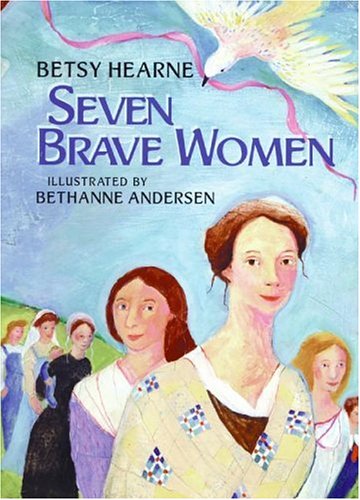
Hearne, B. (2006). Seven Brave Women. New York: HarperTrophy.
Betsy Hearne has her Ph.D. from the University of Chicago’s Graduate Library School and was a book editor for Booklist and The Bulletin of the Center for Children’s Books. She has written and edited books for children as well as adults, and her book Seven Brave Women is a winner of multiple awards, including the Jane Addams Book Award, which focuses on books that promote peace, social justice, and community. The author speaks about the creation of the story on the website for the University of Chicago (http://people.lis.uiuc.edu/~ehearne//longbio.html): “Seven Brave Women didn't take very long to write, but it took my whole life to hear. And the best thing about it is the way those women wanted to share, not star, and the way readers have shared their own family stories in return. Listening is still the best thing I ever learned.” Hearne has a passion for storytelling and listening that comes out in her book.
An excerpt from the introduction to Seven Brave Women reads: “My mother does not believe that wars should be fought at all. She says history should be her story, too, and she tells stories about all the women in our family who made history by not fighting in wars” (1). The book is broken into chapters, and chapters 1-7 chronicle the lives of seven women throughout history and their roles of bravery. The roles are as simple as remembering stories, and as complex as opening hospitals. The last chapter of the book is written in first person, and reveals a young girl’s plans for herself for the future.
There are no pictures of men in the book, and there is not much mention of them. When they are mentioned, they are supporting characters; it is clear that this story is about women. However, it is clear that the women in the book do not hate men. Many of them were married with children, and they are portrayed as caring for their families deeply. The illustrations in the book show women as capable, powerful, and strong, while still being caring and polite. The women are inventive, assertive, and all can be considered positive role models, no matter what their contribution to history. This book was so powerful because it gives a variety of important messages to young readers, no matter what their gender. Women are powerful, capable people who can solve problems and be brave and heroic. The story also promotes creativity, determination, and peace.
I Live With Daddy
Vigna, J. (1997). I Live With Daddy. Morton Grove: Albert Whitman & Company.
Judith Vigna is a hugely popular children’s author. She writes about difficult issues for children including death, alcoholism, divorce, and loss. Many educators have utilized her books as resources and there are many extension activities available on the internet incorporating Vigna’s books. Her books received positive reviews from people looking to teach children about sensitive and difficult subjects.
The story is told by Olivia, a young girl whose parents are divorced. In contrast to popular portrayals of divorced families, Olivia lives with her father. She reveals that she misses her mother and mostly sees her on TV since she is a reporter. Her father is kind and patient, and he and Olivia share some responsibilities, like cleaning the house. Vigna writes that Olivia goes on some adventures with her mom, and it is obvious that she looks up to her as she chooses to write a story about her mother’s life for Writer’s Day at school. Her mother promises to attend and Olivia is very excited. However, her mother does not show up on time, and Olivia is very angry and hurt. She realizes that “Daddy never missed anything, even if he had to leave work early” (21). She does not want her dad to feel left out because she wrote her story about her mother’s life. Olivia decides to dedicate her book to her father, and they are seen reading her story together on the last page.
In the book’s illustrations, we see Olivia’s father vacuuming, cooking dinner, reading to her, and being a very supportive parent in both traditional “mother” and “father” roles. He even helps her write and edit her story which is written about her mother’s new life. This book was powerful because Olivia’s father is such a positive, strong, supportive presence in her life. It is also notable that he always tells Olivia how much both of her parents love her. There is not any animosity portrayed, even though the parents are divorced and the father spends almost all of the time with Olivia. One problem with the book is the portrayal of the mother. She is consistently late or too busy to spend time with Olivia. However, Olivia does not seem to mind most of the time, and reveals that her father does an excellent job caring for her. This book was so powerful because it reverses a traditional image of children of divorce. Even though the book features a negative portrayal of a woman, the positive portrayal of the father outweighs this problem in this context. Also, fathers are frequently absent or disengaged in children’s literature, so the positive portrayal of Olivia’s father in both parental roles is a positive image for children. This book also addresses the issue of divorce, obviously. Further, Olivia is a strong female main character. She is able to think critically and solve her problems when she thinks back to the author’s visit to class, and decides to dedicate her book to her father.
Mama Zooms

Cowen-Fletcher, J. (1993). Mama Zooms. New York: Scholastic Book Services.
Jane Cowen-Fletcher is the author of Mama Zooms. She has written at least ten other books besides this story. It was difficult to find her personal website or information about her, but there were a wide variety of sources for book reviews. She received positive reviews from every source I examined. Her books have also been published in Spanish. Her books seem to be focused toward younger readers and she often writes about families, relationships, and development.
Mama Zooms is a book for young readers. It chronicles the adventures of a small boy and his mother. The story, told from the child’s perspective, features a wide variety of make-believe escapades that he and his mother go on in her “zooming machine”. We find out that the zooming machine is actually a wheelchair. Throughout the book, the mother is depicted as adventurous and fun-loving, with “very strong arms from all our zooming” (21). This book portrays the child’s mother as capable and confident. She is not hindered by the fact that she is a woman or the fact that she has a disability. In the illustrations, the mother and son are pictured smiling and have a close bond. The father is present in the book. He is seen briefly at the beginning. At the end of the story, we can see that the family has a strong support system as the father and son help push the mother’s wheelchair up a steep hill. The last illustration shows the family together with the little boy sitting on his mother’s lap, holding his father’s hand.
This book is an excellent choice for young readers for a variety of reasons. The mother-son relationship is portrayed as loving and healthy. Although the father is not seen throughout most of the story, he is shown as supportive and the family functions well together. The mother is a positive female role model. This book can also be used to educate children about loved ones with disabilities. The only issue of concern was the fact that the father was absent throughout most of the book, which is common in children’s literature. However, the strength and positivity of the mother as a role model, despite her disability, outweighs this concern, especially since the family seems to function well as a supportive unit when the father is present.
Friday, November 21, 2008
The Breaking Point
Last night, November 20, I attended an event called “The Breaking Point”. It was put on by RHA and discussed stress, depression, and anxiety on college campuses. There was a panel of students, as well as representatives from MSU’s Counseling Center. A video was also played, where students on campus were interviewed about what stresses them out the most about being in college. There was a heavy focus on diversity and fitting in, and the struggles people can go through when they come to college. Some students on the panel talked about feeling alienated because they felt that there was not a place for their culture or lifestyle here at MSU. The representative from the counseling center also talked about how many LGBTQ students are often struggling. Even though the event was focused at students in college, I could definitely relate many of the concepts to the elementary classroom. Elementary students may have many of the same problems that college students have, but they may not be able to vocalize and articulate them as well. I feel like children can be just as stressed as adults, but people often do not recognize their mature feelings and can downplay their issues.
I thought this was a beneficial event for me for a few reasons. I learned that there are counseling services here at MSU, and that there are so many groups of people struggling to find their identity here on this huge campus. Many of the students on the panel talked about having someone to talk to about their difficulties fitting in. I think that part of my role as a teacher in the future is to be a listening ear to students who are having problems, no matter the nature. I got some useful ideas about how to make all diverse students feel welcome and comfort students who feel that there is not a place for them in their community. Again, attending this event reminded me that as a teacher I must challenge myself to include all students in my lessons and classroom community, and value differences and diversity.
I thought this was a beneficial event for me for a few reasons. I learned that there are counseling services here at MSU, and that there are so many groups of people struggling to find their identity here on this huge campus. Many of the students on the panel talked about having someone to talk to about their difficulties fitting in. I think that part of my role as a teacher in the future is to be a listening ear to students who are having problems, no matter the nature. I got some useful ideas about how to make all diverse students feel welcome and comfort students who feel that there is not a place for them in their community. Again, attending this event reminded me that as a teacher I must challenge myself to include all students in my lessons and classroom community, and value differences and diversity.
Subscribe to:
Comments (Atom)
